

What is a Epidural Steroid Injection?
Epidural steroid injection (ESI) is a common treatment option for many forms of low back pain and leg pain. They have been used for sciatica and low back pain since 1952, and are still an integral part of the non-surgical management. The goal of the injection is pain relief. The injection alone can be sufficient to provide relief. But an ESI is commonly used in combination with a comprehensive rehabilitation program to provide additional benefit.
ESI’s can provide relief from pain anywhere from one week up to one year. An injection can provide sufficient pain relief to allow a patient to progress with a rehabilitative stretching and exercise program. If the initial injection is effective for a patient, he/she may have up to three in a one-year period.
In addition to the low back (the lumbar region), epidural steroid injections are used to ease pain experienced in the neck (cervical) region and in the mid spine (thoracic) region.
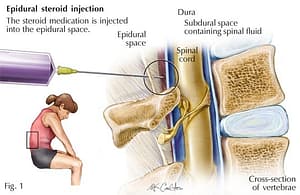
An epidural steroid injection delivers steroids directly into the epidural space in the spine.
Common Conditions Treated by Steroid Injections
Several common conditions that cause severe acute or chronic low back pain and/or leg pain (sciatica) from nerve irritation can be treated by steroid injections. These conditions include:
- A lumbar disc herniation, where the nucleus of the disc pushes through the outer ring (the annulus) and into the spinal canal where it pressures the spinal cord and nerves.
- Degenerative disc disease, where the collapse of the disc space may impinge on nerves in the lower back. See Lumbar Degenerative Disc Disease (DDD).
- Lumbar spinal stenosis, a narrowing of the spinal canal that literally chokes off nerves and the spinal cord, causing significant pain. See What is Spinal Stenosis?.
- Compression fractures in a vertebra. Read When Back Pain is a Spine Compression Fracture.
- Cysts which are in the facet joint or the nerve root and can expand to squeeze spine structures. See Synovial Cyst in the Lumbar Spine.
- Annular tear, a painful condition where a tear is present in the outer layer of the disc. SeePain Generated by the Spinal Disc.
For these and many other conditions that can cause low back pain and/or leg pain (sciatica), an epidural steroid injection may be an effective non-surgical treatment option.
How Epidural Steroid Injections Work?
An epidural steroid injection delivers steroids directly into the epidural space in the spine. Sometimes additional fluid (local anesthetic and/or a normal saline solution) is used to help ‘flush out’ inflammatory mediators from around the area that may be a source of pain.
The epidural space encircles the dural sac and is filled with fat and small blood vessels. The dural sac surrounds the spinal cord, nerve roots, and cerebrospinal fluid (the fluid that the nerve roots are bathed in).
Typically, a solution containing cortisone (steroid) with local anesthetic (lidocaine or bupivacaine), and/or saline is used.
- A steroid, cortisone e.g., is usually injected as an anti-inflammatory agent. Inflammation is a common component of many low back conditions and reducing inflammation helps reduce pain. Triamcinolone
- Lidocaine is a fast-acting local anesthetic used for temporary pain relief.
- Saline is used to dilute the local anesthetic or as a ‘flushing’ agent to dilute the chemical or immunologic agents that promote inflammation.
Are Epidural Steroid Injections Effective?
Although many studies document the short-term benefits of epidural steroid injections, the data on long-term effectiveness are less convincing. Indeed, the effectiveness of lumbar epidural steroid injections continues to be a topic of debate. This is accentuated by the lack of properly performed studies.
For example, many studies don’t include use of fluoroscopy or X-ray to verify proper placement of the medication. Despite the fact that fluoroscopic guidance is routinely used for the procedure. Additionally, many studies don’t classify patients according to diagnosis and tend to ‘lump’ different types sources of pain together. These methodological flaws tend to make interpretation and application of study results difficult to impossible.
More studies are needed to define the role of epidural steroid injections in low back pain and in sciatica. Despite this, most studies report that more than 50% of patients find measurable pain relief with ESIs. They also underscore the need for patients to enlist the services of professionals with extensive experience administering injections, and who always use fluoroscopy to ensure accurate placement.
What Are Benefits of Epidural Steroid Injections?
Epidural steroid injections deliver medication directly (or very near) the source of pain generation. In contrast, oral steroids and painkillers have a dispersed, less-focused impact and may have unacceptable side effects. Additionally, since the majority of pain stems from chemical inflammation, an epidural steroid injection can help control local inflammation. While also “flushing out” inflammatory proteins and chemicals from the local area that may contribute to and exacerbate pain.