

What is a Lumbar Sympathetic Block?
A lumbar sympathetic block is an injection of local anesthetic into, or around the sympathetic nerves. These sympathetic nerves are a part of the sympathetic nervous system. The nerves are located on the either side of spine, in the lower back. Normally these nerves control basic functions like regulating blood flow. In certain conditions, these sympathetic nerves can carry pain information from the peripheral tissues back into the spinal cord.
What is the purpose of a lumbar sympathetic block?
A lumbar sympathetic block is performed to block the sympathetic nerves that go to the leg on the same side as the injection. This may in turn reduce pain, swelling, color, sweating and other unusual changes in the lower extremity and may improve mobility. It is done as a part of the treatment of Reflex Sympathetic Dystrophy (RSD), Sympathetic Maintained Pain, Complex Regional Pain Syndrome and Herpes Zoster (shingles) involving the legs. Certain patients with neuropathy or peripheral vascular disease may also benefit from lumbar sympathetic blocks.
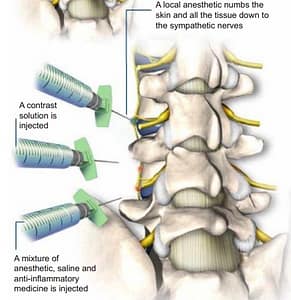
A lumbar sympathetic block is performed to block the sympathetic nerves that go to the leg on the same side as the injection.
How is the lumbar sympathetic block performed?
It is done with the patient lying on stomach. The patients are monitored with EKG, blood pressure cuff and an oxygen-monitoring device. Temperature sensing probes may also be placed on your feet. The lumbar sympathetic block is performed under sterile conditions. The skin on back is cleaned with antiseptic solution and the skin is then numbed with a local anesthetic. Then X-ray is used to guide the needle or needles into the proper position along the outside of the spine.
Once in place, a test dose of dye is used to confirm that the injected medication will spread in an appropriate area. If this is okay, the injection takes place gradually over several minutes. The physician will use the X-ray to evaluate the spread of the injected medication. When a sufficient area is covered, the injection will be over. When done, the needle is removed and a Band Aid is applied.
What should I expect after the lumbar sympathetic block?
Immediately after the injection, you may feel your lower extremity getting warm. In addition, you may notice that your pain may be gone or quite less. You may also notice some temporary weakness or numbness in the leg, although this is actually not a desired effect of a lumbar sympathetic block.
You should have a ride home. We advise the patients to take it easy for a day or so after the procedure. Perform the activities that you can tolerate. Some of the patients may go for immediate physical therapy.
Unless there are complications, you should be able to return to your work the next day. The most common thing you may feel is soreness in the back at the injection site.
The local anesthetic wears off in a few hours. However, the blockade of sympathetic nerves may last for many more hours. Usually, the duration of relief gets longer after each injection.
If you respond to the first injection, you will be recommended for repeat injections. Usually, a series of such injections is needed to treat the problem. Some may need only 2 to 4 and some may need more than 10. The response to such injections varies from patient to patient.
What are the risks and side effects of a lumbar sympathetic block?
This procedure is safe. However, with any procedure there are risks, side effects and possibility of complications. The most common side effect is temporary pain or soreness at the injection site. Uncommon risks involve bleeding, infection, spinal block, epidural block and injection into blood vessels and surrounding organs. Fortunately, the serious side effects and complications are uncommon.